1 What is an ESM?
Earth System Models are a numerical representation of the physical, chemical, and biological processes that operate across the atmosphere, cryosphere, ocean, and land. They use mathematical laws and equations to simulate how climate has changed in the recent and even distant past, and how it might evolve in the future, subject to different plausible scenarios of future human development and greenhouse gas emission pathways.
You may have heard the terms climate model, Earth System model (ESM), general circulation model (GCM) and coupled atmosphere-ocean general circulation models (AOGCMs). These are not all interchangeable! Historically, a ‘climate model’ referred to AOGCMs or GCMs, which do not simulate biogeochemical processes. ESMs, on the other hand, evolved from GCMs to simulate ocean chemistry and marine plankton due to their importance in carbon cycling. As such, ESMs simulate the 3D evolution of the ocean and its biogeochemical processes.
The Coupled Model Intercomparison Project (CMIP) is currently in its sixth iteration, and coordinates the release and updates of climate models in line with the schedule of the Intergovernmental Panel on Climate Change (IPCC) assessment reports. CMIP6 consists of ‘runs’ or model results from ~100 distinct climate models produced across 49 different modeling groups around the world.
1.1 Experiments
Modelers run different experiments to simulate past, present and future climates (e.g., what would happen if we suddenly quadrupled CO2, or, if CO2 gradually increased from pre-industrial levels by 1% per year). A full list of CMIP6 experiments can be found here.
Not all modeling centers run the same experiments in their ESMs. However, each ESM contains the historical simulation, where the ESM is run over the historical period, defined as 1850-2014. The historical runs are not fit to observed data, but rather, emerge from the physics of the model. This allows modelers to run hindcasts of the model (i.e., predictions of past climate), which are then compared to recorded climate observations. If the hindcasts are good at simulating observed reality, this gives modelers more confidence in the model projections.
Another set of experiments are future warming scenarios, termed SSPs, which are detailed below.
1.2 Climate scenarios (SSPs)
Climate scenarios represent plausible storylines of future changes in population, demographics, and energy use. In CMIP5, scenarios were expressed as representative concentration pathways (RCPs) which describe greenhouse gas emission pathways (offset by other emissions) that result in specified levels of radiative forcing in 2100.
In CMIP6, climate scenarios now incorporate narratives describing alternative shared socioeconomic pathways (SSPs), particularly relating to the Paris Agreement. The five most common SSPs in CMIP6 are listed below (sensu Table 2 and Figure 1 in (Schoeman et al. 2023)).
| Scenario | Description | Warming relative to preindustrial (90% confidence interval) |
| SSP1-1.9 | Net zero CO2 emissions achieved by mid-century; avoids exceeding 1.5°C of warming, in line with the ambition of the Paris Agreement | Stabilises at 1.4°C (1.0–1.8°C), with minimal overshoot beyond 1.5 °C |
| SSP1-2.6 | Net zero CO2 emissions achieved in the latter part of this century; achieves the goals of the Paris Agreement by avoiding 2°C of warming | Stabilises at 1.8°C (1.3–2.4°C) |
| SSP2-4.5 | Approximates current climate policy, although this will change with commitments at each successive Conference of the Parties | 2.7°C (2.1–3.5°C) by 2100 |
| SSP3-7.0 | Approximates a situation under which no new climate policy is implemented, resulting in a doubling of CO2 by 2100 | 3.6°C (2.8–4.6°C) by 2100 |
| SSP5-8.5 | An extreme counterfactual scenario under which CO2 emissions double by mid-century and increase thereafter | 4.4°C (3.3–5.7°C) by 2100 |
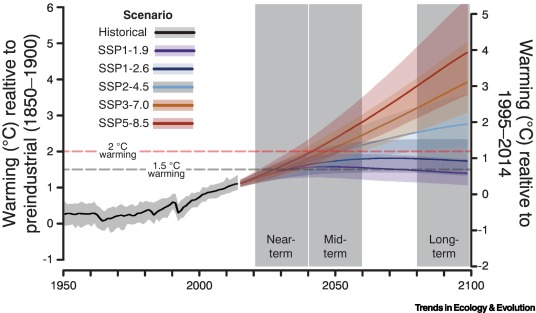
1.3 ESMs we’re using today!
Today, we are using ocean temperature output from two ESMs, that are part of the CMIP6 effort: ACCESS-CM2 (Bi et al. 2020) and IPSL-CM6A-LR (Boucher et al. 2020). We are using output for two climate scenarios: SSP2-4.5 and SSP5-8.5.
Below, we’ve detailed key sub-model components for those interested:
ACCESS-CM2 represents one of Australia’s contributions to CMIP6.
- Atmosphere: UM10.6 GA7.1
- Land surface: CABLE v2.5 (coupled to the UM)
- Sea ice: CICE5.1.2
- Ocean: MOM5
- Numerical coupler: OASIS3-MCT
IPSL-CM6A-LR represents one of France’s contributions to CMIP6.
- Atmosphere: LMDZ6A-LR
- Land surface: ORCHIDEE v2.0
- Ocean: NEMO v3.6
- Sea ice: NEMO-LIM
- Ocean biogeochemistry: NEMO-PISCES-v2
- Numerical coupler: OASIS3-MCT